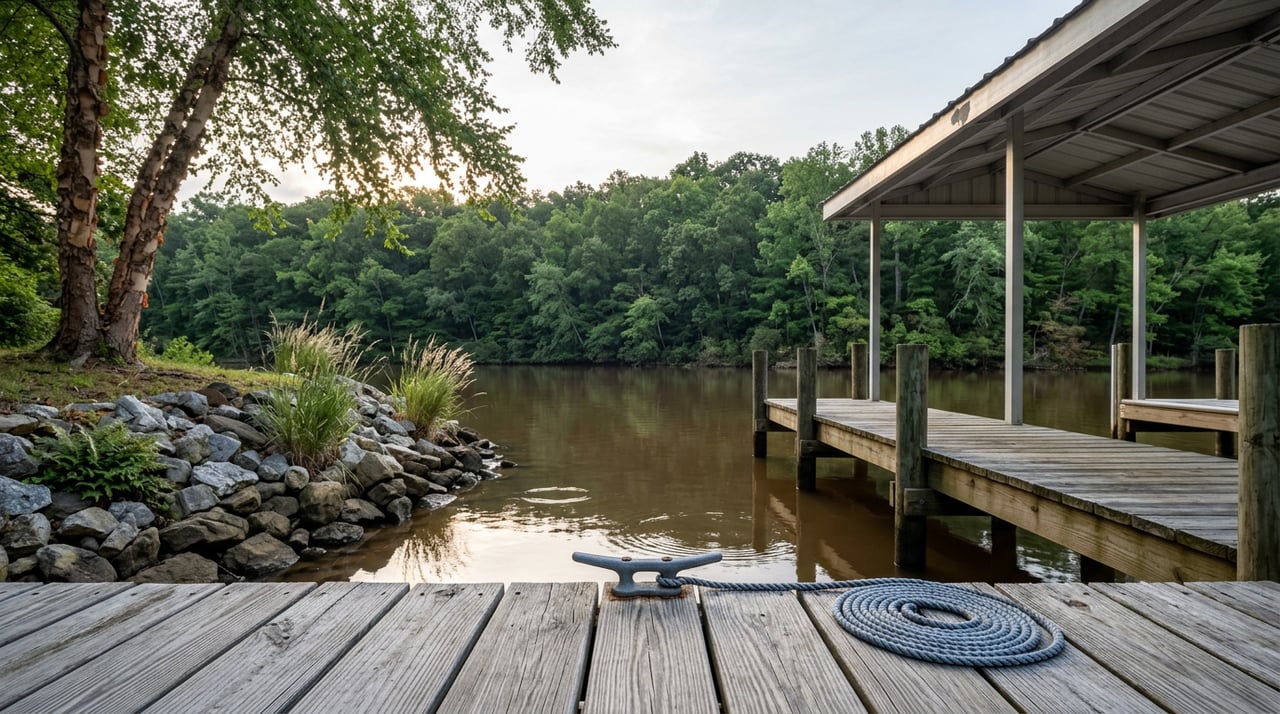
You've toured the house. You've walked the dock, felt it hold steady under your feet, pictured the boat tied up by June. The listing calls it a dockable lakefront lot on Watts Bar Lake, and in your head the dock is already part of the deal, the same as the water heater or the ceiling fans.
It isn't. The dock sits on land the Tennessee Valley Authority controls, and the permit that allows it to exist belongs to the seller, not the property. When the sale closes, that permit does not transfer with the deed. The new owner has to request a transfer, by name, within 60 days of closing.
A Permit Attached to a Person, Not a Piling
Most structures on Watts Bar Lake sit inside what TVA calls the flowage easement, a strip of shoreline the agency owns or controls even when the adjoining house is privately owned. Anything built there, a dock, a boathouse, a seawall, exists under a Section 26a permit issued to a specific person.
Sell the house and that permit stays put in name only. TVA is explicit that the new owner must file a Transfer of Ownership within 60 days of closing. That 60-day deadline begins when title changes hands.
What Happens If You Miss the Window
The dock most buyers actually want to keep is the one already in the water, often built years before the current owner even purchased the home. TVA grandfathers structures permitted before November 1, 1999, the date its current Shoreline Management Policy took effect, as long as they were built exactly to the specifications on file. That grandfathering is not permanent protection. Every time ownership changes, the new owner has to file a Transfer of Ownership to keep it.
If the dock has a covered second story, for instance, current regulations only allow an open deck up there. A roofed or enclosed second level built decades ago under older rules can be ordered removed.
This is the detail that turns a straightforward lakefront purchase into a liability nobody priced in. You didn't build the dock. You didn't make the modification that put it out of compliance. But if the transfer paperwork sits unfiled past day 60, the compliance problem becomes yours.
The Bill Depends on What You're Asking For
Waterfront Permitting Services lists these TVA fees:
| Filing type | Fee |
|---|---|
| Transfer ownership only, no changes | $250 |
| Transfer plus modification to the structure | $500 |
| Brand new permit application | $1,000 |
That $1,000 figure reflects a fee increase that took effect in early January 2025, so anyone quoting an older number from a pre-2025 blog post or forum thread is working from stale math. The gap between the transfer fee and the new-permit fee is also the clearest financial argument for filing on time. Missing the window and getting bumped into new-application territory doesn't just cost more time, it costs four times the fee.
Timing estimates for how long the process actually takes are where things get less clean. A widely cited lake-living guide puts routine dock permitting at 30 to 60 days. A firm that has filed more than 250 TVA permits across Watts Bar and other Tennessee Valley reservoirs quotes 100 to 150 days for the same process, with ramps or dredging work adding another 3 to 4 months on top. Both figures come from people who work in this system regularly. The honest takeaway isn't that one source is wrong, it's that TVA's own processing time isn't predictable enough for a buyer to promise themselves a working dock by a specific date on the calendar. If you're closing in March hoping to swim off your own dock by Memorial Day, that hope is a bet, not a plan.
Why Some Buyers Near Kingston Skip the Filing Entirely
Not every dockable purchase on this stretch of Watts Bar Lake runs through an individual 26a application. Gated lake communities within reach of Kingston, like Grande Vista Bay and The Docks at Caney Creek, build their marinas once, permit them once, and then lease or assign slips to residents. Buy into one of those neighborhoods and you're stepping into an already-solved permitting problem instead of opening a new one.
That convenience shows up in what buyers are willing to trade for it. A private dock on your own shoreline is the premium option in the Watts Bar market, but it comes with the transfer clock attached. A community slip trades some of that exclusivity for a dock that's already resolved with TVA before you ever sign a contract.
It's also worth looking at how long homes are actually sitting on the Watts Bar market before closing. As of mid-July 2026, homes in the Watts Bar Lake area were averaging around 106 days on market with a median list price near $425,000. Some of that timeline is ordinary negotiation. Some of it is buyers and their agents working through exactly this kind of dock paperwork before they're comfortable signing, particularly on older waterfront properties where nobody is quite sure whether the last transfer was ever filed.
Kingston's Real Advantage Isn't the Dock
None of this is a reason to avoid Kingston or avoid a dockable lot. Kingston sits at the confluence of the Clinch and Tennessee Rivers and offers roughly a 35 to 40 minute drive to Knoxville via I-40, the shortest commute of any town on the Watts Bar shoreline. That single fact is why buyers keep choosing Kingston over quieter, cheaper stretches of the same lake further south. The dock permit process is friction, real friction with a real deadline, but it's friction that comes with the territory of buying into a federally managed reservoir. It doesn't change why Kingston is worth the drive to look at in the first place.
What it does change is how you should treat the dock during due diligence. Ask for a copy of the current permit before you're under contract. Ask whether it has ever been transferred since it was issued. Ask whether anything on the dock, especially a covered upper level, was added without a matching TVA approval. Those three questions cost you nothing and tell you more about your real closing timeline than the listing photos ever will.
Frequently Asked Questions
Does every dock on Watts Bar Lake require a TVA permit? Any dock, pier, boathouse, or shoreline alteration on TVA-controlled land requires a Section 26a permit.
What if the seller tells me the dock is already fully permitted? Ask to see the permit itself, not just a verbal assurance.
Does Watts Bar Lake drop dramatically in winter like some other Tennessee lakes? No. Watts Bar is a mainstream reservoir, so its seasonal drawdown is modest compared to tributary lakes, which means most docks stay usable through the colder months rather than sitting on exposed mud flats.
If you're weighing a private dock against a community marina, or you just want someone who has watched this exact permit timeline play out on real Kingston closings, Christina Branham can walk you through what to ask for before you write an offer. Search Listings or Contact Christina to start with a property, not a surprise.
This article is general information, not legal, tax or financial advice. Consult a qualified professional about your situation.